Asana is an excellent task list. It captures everything your team tells it. The moment your team stops telling it things — it goes quiet.
S-BIZ is fundamentally different. It monitors every task continuously and alerts the right people the moment something starts to slip — whether or not anyone has updated the system.
Asana can tell you what tasks exist, what their stated status is, and when they are due. It cannot tell you whether any of that reflects reality.
If a task is marked "In Progress" but the person assigned to it has not touched it in eight days — Asana does not know. If a task is behind its expected pace but nobody has updated the percentage — Asana does not flag it. If a deadline is tomorrow and the task is 20% complete — Asana is silent until someone checks.
This is not a criticism of Asana. It is the structural constraint of any passive tool. Passive tools show what people enter. They cannot evaluate the objective state of the work.
S-BIZ is the first platform in the Work Execution Assurance category. It evaluates the objective state of every task continuously — comparing completion against elapsed time, checking for owners, tracing dependency cascades — and surfaces the problem the moment it forms.
S-BIZ is the world's first Work Execution Assurance platform. The comparison below is not about features — it is about fundamental category differences.
| Capability | S-BIZ | Asana |
|---|---|---|
| Real-time continuous monitoring | ✓ Evaluates every task on every change, automatically | ✗ Passive — records what users enter |
| Proactive violation alerts | ✓ Fires the moment a rule breaks — no manual setup | ✗ Notifications only when due dates pass or status changes |
| Works without team updating it | ✓ Detects stale tasks and behind-pace work independently | ✗ Entirely dependent on team discipline to stay current |
| Violation auto-detection (16 rule categories) | ✓ Missing owner, overdue, behind schedule, stalled, blocked cascade | ✗ No structured violation engine |
| Dependency cascade tracking | ✓ Full upstream / downstream mapping, propagated automatically | ✗ Basic dependency links — no cascade alerting |
| Actionable fix recommendations | ✓ Specific HOW for every violation, with resolution count | ✗ Alerts only — no structured guidance |
| Derived project health (not self-reported) | ✓ Calculated from objective task state — cannot be gamed | ✗ Health depends on status fields people manually update |
| Structural validation during setup | ✓ Flags missing owners, conflicting dates the moment created | ✗ No validation — errors are silent until discovered |
| Manager cross-portfolio view | ✓ All projects, all violations, one dashboard | ✗ Portfolio view available in Business tier only |
| Private database per company | ✓ Dedicated, isolated instance — your data only | ✗ Shared SaaS infrastructure |
| Violations auto-clear when fixed | ✓ System re-evaluates and clears automatically on resolution | ✗ No violation lifecycle — manual status updates only |
| Three integrated views (Gantt, Kanban, My Tasks) | ✓ All three built-in, intelligence active across all views | ✗ Timeline and Board available but no active intelligence layer |
Your client presentation is Friday. Three tasks are behind pace. A key deliverable has no owner. The person blocking the design work hasn't responded in four days.
Asana shows three tasks as "In Progress." Nobody has updated them since Monday. The system has no way to know anything is wrong.
No alert fires. No manager is notified. The blocked task sits silently, its status unchanged. The unowned deliverable waits with no responsible person.
You find out Friday morning when the team admits the presentation is not ready. The client meeting moves. The client's confidence takes a hit.
S-BIZ evaluates the objective state of every task. By Wednesday afternoon, it has detected three violations: two tasks behind schedule by more than 15%, and one task with no owner and a two-day deadline.
The manager receives an alert. The task owners are notified. The blocked deliverable gets assigned immediately. The behind-schedule tasks are reprioritised.
By Thursday morning the team has recovered. The presentation ships on time. The client never knew there was a risk.
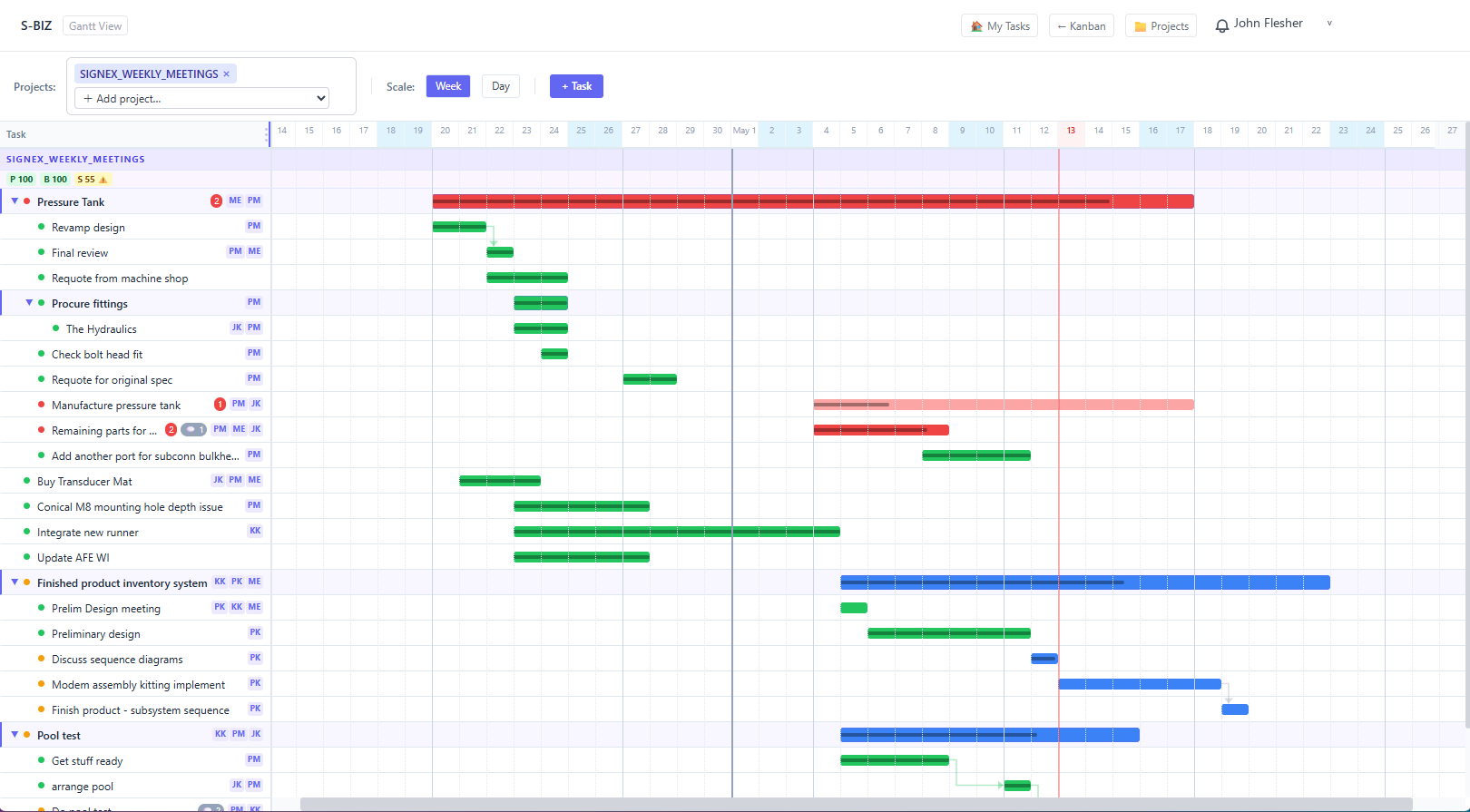
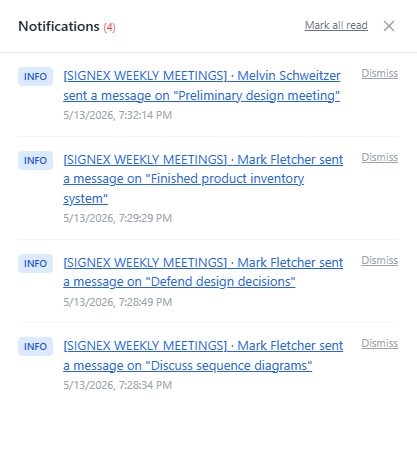
Three views, one continuous intelligence layer. Every violation surfaces in the Gantt, the Kanban, and in real-time notifications — exactly where the work lives.
The Gantt timeline is the primary view. Task bars are colour-coded by health — grey for open, blue for on-track, green for complete, and pink-to-red for tasks with violations. The darker the red, the more severe. Click any bar to open the task detail — violations, recommendations, and fix guidance in one place.
S-BIZ is designed for teams that use Asana and find themselves doing the work Asana can't. If any of the following describes your week, S-BIZ solves exactly that.
If your team uses Asana and you still find yourself chasing status, S-BIZ is built to solve that. The moment something slips, you know — before the client does.
We are accepting 5 companies into our founding cohort.
Try S-BIZ with your team fully supported. If you stay on, it is $5 per team member — locked in as your founding rate.